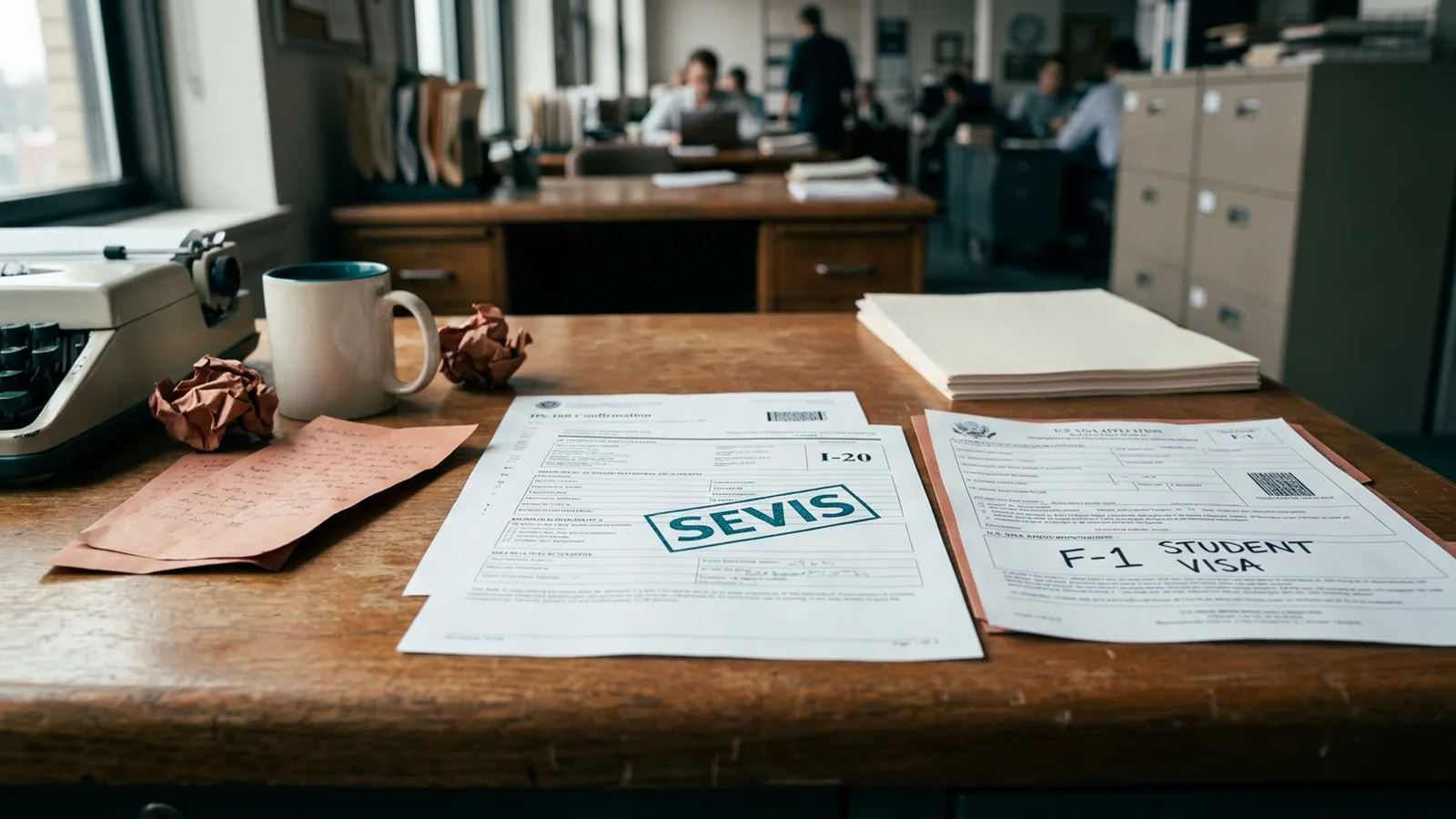
The F-1 visa is the student visa for people accepted at a U.S. school approved by the government. The Department of State says the process begins after the school, approved by SEVP, registers you in SEVIS and issues Form I-20. From there, the order is: SEVIS fee, DS-160 form, visa fee, interview, and documents.
What is the F-1 visa?
The F-1 is the nonimmigrant visa for people who will pursue an academic or language course at an approved school. According to the Department of State, you need to be accepted by a SEVP-approved school before applying for the visa. The consulate decides on the visa during the interview; the school confirms your acceptance through the I-20.
What is Form I-20?
The I-20 is the Certificate of Eligibility for Nonimmigrant Student Status. It confirms that the student has been accepted into an approved program. According to the DHS Study in the States program, only a DSO (Designated School Official) from a SEVP-certified school can issue the I-20.
The form includes personal and academic information, the SEVIS ID number, the school's SEVIS code, program dates, and financial information. The DSO and the student must sign it. When the school sends the I-20 electronically, the student prints and signs it.
What are the steps in the application process?
The Department of State's official student visa page lists these steps (source):
- The approved school registers you in SEVIS and issues the I-20.
- You pay the I-901 SEVIS fee.
- You complete the online DS-160 form and print the confirmation page to bring to the interview.
- You pay the visa application fee.
- You schedule the interview at the nearest U.S. embassy or consulate.
- You gather the documents and attend the interview.
How much do the fees cost?
The visa application fee is $185, non-refundable, according to the Department of State. The I-901 SEVIS fee for F-1 and F-2 is $350, according to ICE. For J-1, the amount listed by ICE is $220. Always check the official pages on the payment date, as amounts may be updated.
ICE states that the payment receipt is printed on the fmjfee.com website, with the SEVIS ID, last name, and date of birth. Payment can be made by credit card in U.S. dollars, check, money order, or Western Union.
What documents should you bring to the interview?
The Department of State indicates that you should bring (source):
- Passport.
- DS-160 confirmation page.
- Visa fee receipt.
- A photo.
- Form I-20, signed by you and a school official.
During the interview, the consular officer may request evidence of academic preparation and of how the student will pay for study, housing, and travel costs. Each consulate may request additional documents; the full list is on the page of the consulate where you scheduled your appointment.
What are the issuance and entry deadlines?
Two deadlines appear on the official page. The visa can be issued up to 365 days before the course start date. And you will not be able to enter the U.S. with a student visa more than 30 days before the course start date. In other words, having the visa in hand does not mean you can enter at any time.
How do the school and the consulate divide the work?
These are two separate steps. The school handles the I-20: the DSO issues the form and registers the student in SEVIS (DHS). The consulate handles the visa: it receives the DS-160, conducts the interview, and makes the decision (Department of State). One step does not replace the other, and the I-20 comes before everything else.
In what order should you prepare the documents?
A practical order, based on the official steps: first, keep the signed I-20 and note the SEVIS ID, since that number is needed to pay the I-901 fee (DHS). Then, pay the SEVIS fee and print the receipt (ICE). Next, complete the DS-160, print the confirmation, and pay the visa fee. Finally, schedule the interview and gather your passport, photo, receipts, and evidence of academic preparation and ability to cover study costs.
Each step produces a document you will need at the interview. Keeping the receipts in the same folder, in order, avoids searching for documents while waiting in line at the consulate.
And the 4-year rule for students?
The Federal Register of July 17, 2026 published a document on a fixed time period of admission and an extension of stay procedure for nonimmigrants, which addresses the length of stay for students. This topic has its own page: see The 4-Year Rule: The New F-1 Student Visa Deadline and, for J-1, The End of Duration of Status: What Changes for J-1 Visa Holders.
Where does Prime come in?
Prime Immigration Office organizes documents and helps fill out forms with the information you provide. The consulate is the one who decides on the visa. To understand the role of each professional, read what an immigration paralegal does and does not do. Find more content on our blog.
Sources
- Department of State: Student Visa
- ICE: I-901 SEVIS Fee
- DHS Study in the States: Understanding the Form I-20
Educational information, not legal advice. Prime Immigration Office is a paralegal service — document preparation only. For legal advice, consult a licensed Texas attorney or DOJ-accredited representative.