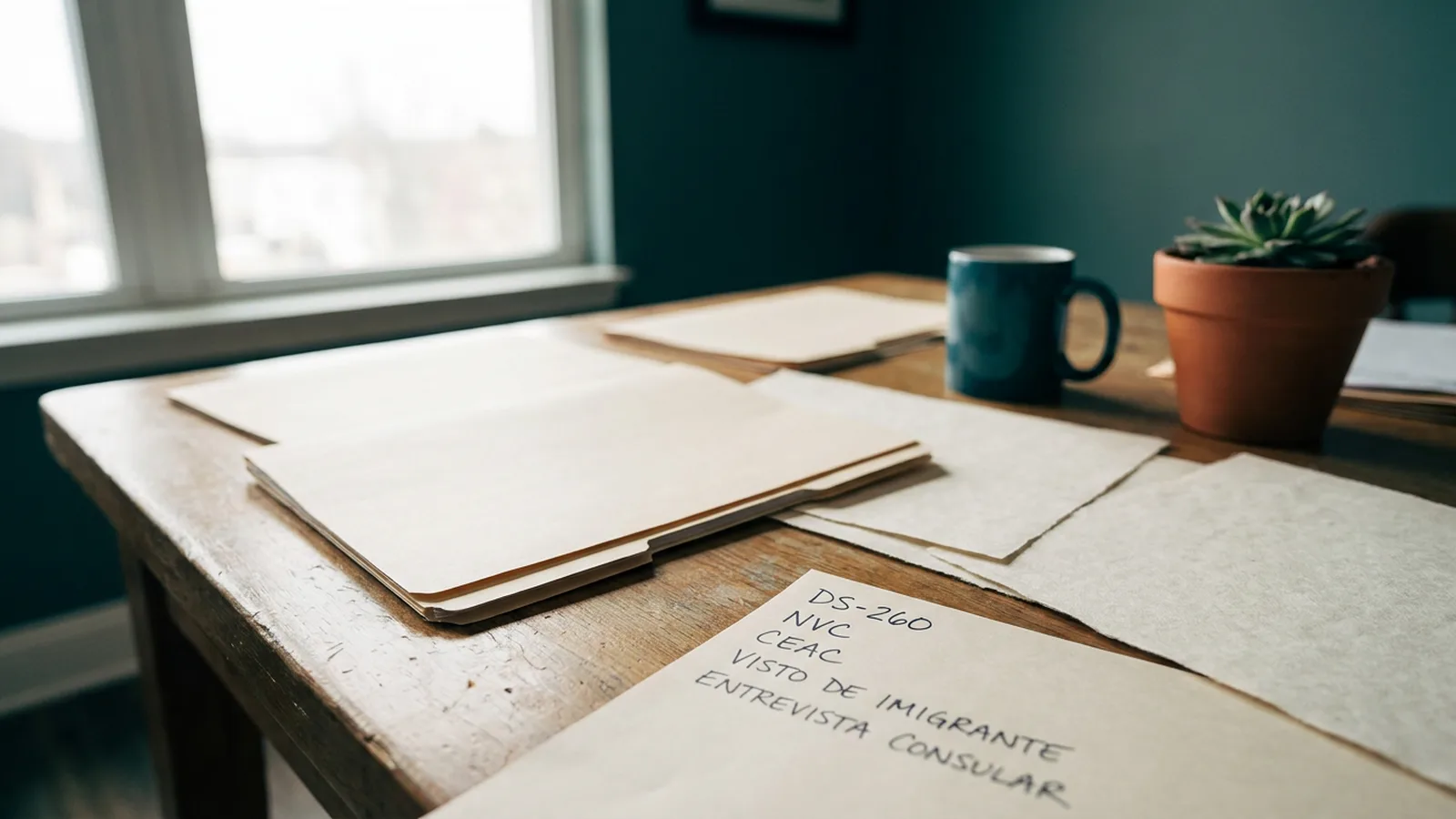
The consular process for an immigrant visa is the sequence of steps the U.S. Department of State describes after USCIS approves a petition: the National Visa Center (NVC) opens the case, fees are paid, the DS-260 form is completed, documents are submitted, and the interview takes place at the consulate.
How does the consular process begin?
Everything starts with an approved petition. According to the Department of State, the petition must be approved by USCIS before the case can move forward to the NVC. In family-based immigration, the petition is Form I-130; in employment-based immigration, the employer files Form I-140. The consular process is the path for those who receive the visa outside the country; the path for those already in the U.S. is adjustment of status with Form I-485.
After approval, the NVC creates the case in its system. The official page states that the first step is "the creation of your case in our system" and that the NVC sends a Welcome Letter, by email or mail, with CEAC access information.
What is CEAC and what is it for?
CEAC (Consular Electronic Application Center) is the portal where the case is tracked. According to the NVC, this is where you check status, receive messages, and manage the case. The same page advises checking CEAC for the most up-to-date status and the list of documents still needed.
The NVC page includes a deadline: if NVC notices go unanswered for one year, the petition risks being terminated.
What fees does the NVC charge and how are they paid?
The Department of State's payment page lists two charges: the Immigrant Visa Application Processing Fee (called the "IV Fee" on the payment button) and the Affidavit of Support Fee, which some cases do not need to pay. The page does not list amounts; they appear on the payment screen within CEAC itself.
The official step-by-step is as follows:
- Have on hand the routing number and the checking or savings account number of a U.S. bank.
- Log into the case on CEAC and click "PAY NOW" for the applicable fee. The system does not allow paying both at the same time.
- Wait for processing: the NVC requires 10 calendar days to process fees, and the DS-260 form only becomes available afterward.
If the system charges the Affidavit of Support fee and the case does not meet the criteria described on the page, the Department of State itself advises contacting the NVC before paying.
What is Form DS-260?
The DS-260 is the "Application for Immigrant Visa and Alien Registration." According to the official page for this step, the applicant and each qualifying family member immigrating together must complete the form. It becomes available once the case status in CEAC changes to "PAID," and is accessed through the "START NOW" button under "IV Application" on the case summary page.
First, submitting the DS-260 does not equal formally applying for the visa: the application is only made formal when the applicant is interviewed by a consular officer. Second, the page states that the confirmation page must be printed and brought to the interview; it can be printed from CEAC at any time after the form is completed.
Which civil documents does the Department of State list?
Step 7 covers civil documents. The official list includes:
- original or certified copy of the birth certificate for the applicant and each family member immigrating together;
- police certificates from countries where the applicant has lived, based on age and length of residence, required starting at age 16 (those living in the U.S. do not need a U.S. police certificate);
- original or certified copy of the marriage certificate for every marriage, along with proof of termination of each prior marriage (final divorce decree, death certificate, or annulment document);
- military record, for anyone who served in the armed forces of any country;
- certified copy of court and prison records, when there has been a conviction;
- copy of the biographic data page of a valid passport.
Documents that are not in English or in the official language of the application country require certified translations, with a signed statement from the translator certifying that the translation is accurate and that the translator is competent to translate.
How are documents submitted to the NVC?
Submission is digital. The page for step 9 instructs applicants to log into CEAC and use the "Start Now" buttons for "Affidavit of Support Documents" and "Civil Documents." The "Submit Documents" buttons only become active once all required documents for each person have been uploaded, and clicking them places the case in the NVC's review queue.
The page also states that original documents should never be sent to the NVC, and that mail is only used if the NVC specifically requests it. If the NVC finds incorrect documents, the applicant is notified, makes corrections in CEAC, and resubmits the case using the "Submit Documents" button. Once fees, the DS-260, the Affidavit of Support, and documents are all confirmed, the NVC notifies by email that the case is "documentarily complete" and begins working with the consulate to schedule the interview. The NVC itself states that it cannot predict when a case will be scheduled.
What does the Department of State require for the interview?
The interview preparation page begins with the medical exam, which must be performed by a physician accredited by the embassy (the Panel Physician); exams from other doctors are not accepted. Results may take up to 96 hours. If the physician provides a sealed envelope, it should not be opened: it goes to the consulate and is handed to the officer.
The items the page instructs applicants to bring to the interview are:
- photographs;
- the original or certified copy of each civil document submitted to the NVC;
- original police certificates, valid for two years from the date of issuance;
- the printed DS-260 confirmation page.
The page also notes that the Affidavit of Support and financial evidence already submitted to the NVC do not need to be brought, and that missing items from the list may delay visa issuance.
What happens after the interview?
The page for step 12 describes three possible outcomes. If the visa is approved, the applicant is informed how and when the passport with the visa will be returned, and the visa is affixed to a page in the passport; any errors in the printed information must be reported to the consulate immediately.
Before traveling, the Department of State indicates that the USCIS Immigrant Fee must be paid, and that USCIS will not issue the permanent resident card until the fee is paid. The visa has an expiration date, and entry must occur by that date. A visa does not guarantee admission: the final decision rests with the CBP officer upon arrival, and the principal applicant must enter before or together with derivative family members. Those admitted enter as permanent residents. For information about the document after it is issued, see the guide on Form I-90, Green Card Replacement.
If the officer denies the application under section 221(g), the page explains that this happens when eligibility has not been established; if documents are missing, the officer informs the applicant of what is needed and how to submit it. In cases of administrative processing, the officer advises at the end of the interview, and the Department of State recommends waiting at least 180 days before requesting updates, except in an emergency. In the case of a denial, the officer explains the reason and the next steps.
Where can I track each month's dates?
The priority dates that open up each category are published monthly in the Visa Bulletin, and the NVC refers to it to explain timelines. See more on the Prime blog and in the guide on USCIS biometrics.
Sources
- Department of State: The Immigrant Visa Process
- Step 1: Submit a Petition
- Step 2: NVC Processing
- Step 3: Pay Fees
- Step 6: Online Application (DS-260)
- Step 7: Civil Documents
- Step 9: Submit Documents
- Interview Preparation
- Step 12: After the Interview
Educational information, not legal advice. Prime Immigration Office is a paralegal service — document preparation only. For legal advice, consult a licensed Texas attorney or DOJ-accredited representative.